Home
http://www.virbac.fr/ http://www.boehringer-ingelheim.com/ http://www.novartis.com/ http://www.animalhealth.bayerhealthcare.com/
vetcontact
Vetrinär
Tiermedizin
  WELCOME  
vetcontact
Vetrinär
Tiermedizin
  Home  
  Login / Newsletter  
vetcontact
Vetrinär
Tiermedizin
  CONTACTS  
vetcontact
Vetrinär
Tiermedizin
  Classifieds  
  New Products  
  VetCompanies  
  VetSchools  
vetcontact
Vetrinär
Tiermedizin
  PROFESSION  
vetcontact
Vetrinär
Tiermedizin
  Edutainment  
  VetAgenda  
  Presentations  
  Posters  
  ESAVS  
  Specialisation  
vetcontact
Vetrinär
Tiermedizin
  INSIGHT  
vetcontact
Vetrinär
Tiermedizin
  Congress News  
  Picture Galleries  
  Interferon  
vetcontact
Vetrinär
Tiermedizin
  PRODUCTS  
vetcontact
Vetrinär
Tiermedizin
  Bayer  
  Boehringer Ing.  
  Novartis  
  Virbac

 
  Simply book for less...  
    

Bovine    Equine    Small Animal Practice    Swine Practice    Articles    Vetjournal    
deutsch english español polski francais
Home / WELCOME / Archiv / Small Animal Practice /     
 
PROSTATE CANCER - HIGHER RISK FOR CASTRATED DOGS?
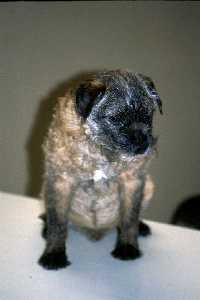
Iff_peterscollection.jpg Picture: © Dr. Stefanie Peters
In many small animal practices, owners are recommended to have male dogs castrated also because of the decreased risk to develop prostate cancer. This study performed on 70 dogs with prostate cancer shows opposite results!

The purpose of this study was to characterize canine prostate cancer using immunohistochemical staining specific for acinar and urothelial/ductal tissue and correlate these results with the dogs` castration status/castration time.

Seventy dogs with prostate cancer were included, 71% were castrated and 29% were intact. Compared with an age-matched control population, castrated dogs were at increased risk of prostate cancer, odds ratio 3.9.
Immunohistochemical staining was performed on 58 cases. Forty-six of the 58 stained positive for cytokeratin 7 (CK 7) (ductal/urothelial origin) and one of the 58 stained positive for prostate-specific antigen. Dogs with CK 7-positive tumours were younger when castrated than dogs with CK 7-negative tumours, 2 versus 7 years (P = 0.03); dogs castrated at 2 years of age were more likely to be CK 7-positive (P = 0.009).

These results show that most canine prostatic carcinomas are of ductal/urothelial, androgen-independent origin. This is consistent with the epidemiological findings, showing increased risk in castrated dogs. Canine prostate cancer may, therefore, not be a realistic model for the human disease.

source: Sorenmo, K. U., Goldschmidt, M., Shofer, F., Goldkamp, C. & Ferracone, J. (2003)
Immunohistochemical characterization of canine prostatic carcinoma and correlation with castration status and castration time.
Veterinary and Comparative Oncology 1 (1), 48-56.
doi: 10.1046/
j.1476-5829.2003.00007.x


Tell a friend   |   Print version   |   Send this article

SMALL ANIMAL PRACTICE

Delayed postpolypectomy bleeding - important risk factorsmembers
Endoscopic polypectomy is very popular in human medicine and is also performed in small animal medicine. Although this evaluation of the risk factors of severe delayed bleeding after polypectomy comes from the human medicine there are some data which might also be of interest in the veterinary field...

  • Breed-specific variations in the histopathology of chronic otitis externamembers
  • Prognostic factors in feline mast cell tumorsmembers
  • Serum hyaluronic acid in dogs with portosystemic shunts prae and post surgerymembers
  • Environmental risk factors for obesity in dogsmembers
  • Sildenafil in canine pulmonary arterial hypertensionmembers
  • Pulsed Wave versus Color Doppler Myocardial Velocity Imagingmembers
  • Continuous versus intermittent feeding by nasoenteric feeding tubesmembers
  • First description of Bartonella koehlerae in dogs with infectious endocarditismembers
  • Relationship between organism and clinical signs in canine endocarditismembers
  • Aspiration of BIPS by a dogmembers
  • Rim Excision in Canine Acanthomatous Ameloblastomamembers
  • Ancillary diagnostic tool for the diagnosis of intraorbital optic nerve lesionsmembers


  • [ Home ] [ About ] [ Contact / Request ][ Disclaimer ]

    Copyright © 2001-2005 VetContact GmbH
    All rights reserved